
Self-custody often starts with a hardware wallet, but the device is only one part of the recovery plan.
If that wallet is lost, damaged, or no longer works, the recovery phrase may be the only route back to the assets.
That makes the backup its own security problem. Paper can burn, fade, get wet or be thrown away.
Screenshots and cloud notes may survive a house fire, but they create digital exposure.
A recovery backup has to solve two problems
BIP39, the standard behind many cryptocurrency recovery phrases, uses an ordered sequence of words selected from a defined list of 2,048 words.
Losing the wallet device does not necessarily mean losing the wallet permanently if that recovery information remains intact.
But preserving it creates two competing requirements.
The backup needs to remain understandable when it is eventually required.
At the same time, it cannot be so exposed that anyone who discovers it can immediately make use of the information.
A sheet of paper scores highly for simplicity. There are no moving parts, batteries or specialist tools involved. Its weakness is physical resilience.
Cloud storage sits at the opposite end of the problem. It can survive physical damage to a home or device, but placing raw seed information online increases its digital attack surface.
Then there is hardware-wallet-only reliance. A device may continue working for years, but treating the original wallet as the recovery plan creates a single point of failure if it is destroyed, lost, or becomes unusable.
This is one reason metal seed backups have become part of the broader self-custody market.
Why metal does not automatically mean secure
Replacing paper with metal addresses several physical risks at once.
Stainless steel and titanium are far less vulnerable to water, heat, humidity, and gradual deterioration, while punched or engraved markings do not depend on ink remaining legible.
That does not make a metal backup infallible.
It can still be stolen. Information can be recorded incorrectly. A holder can forget where it was stored, or create a recovery method that becomes too complicated to reconstruct years later.
Even the physical design introduces trade-offs. Some products use individual letter tiles, others rely on punched markings, and some convert BIP39 words into numerical indexes instead of storing the words themselves.
There is therefore no single physical backup design that optimises durability, readability, privacy and convenience at the same time.
How the main metal seed-storage designs compare
The market can broadly be divided into several approaches: cassette systems, punched stainless-steel tablets, titanium index plates, index-card designs and capsule-style storage.
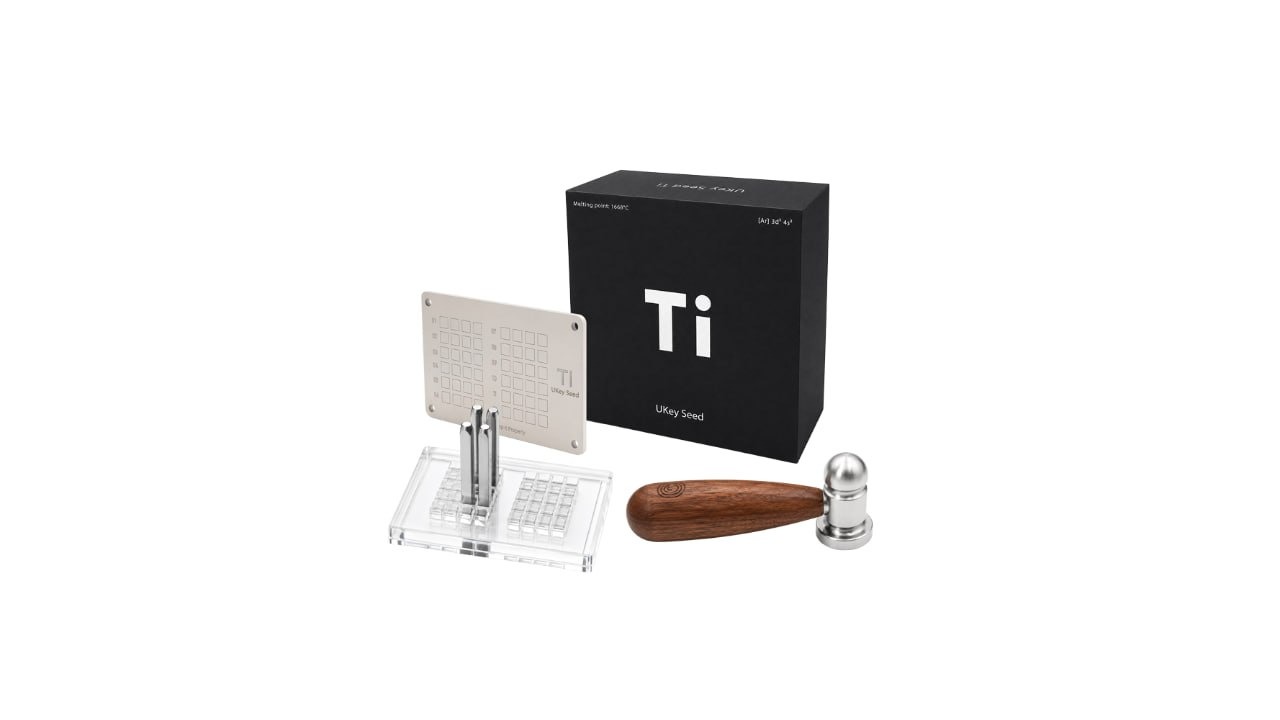
Seen this way, UKey Seed Ti belongs in the index-based group rather than the plain-word storage group.
That distinction matters because the user is not only choosing a material; they are choosing how much of the recovery information is visible if the backup is found.
| Design type | Example | How it records recovery data | Main trade-off |
|---|---|---|---|
| Tile/cassette | Billfodl | Character tiles are inserted into a steel chassis. | Simple to read during recovery, but relies on many small parts. |
| Punched steel tablet | Keystone Tablet Punch | Characters are punched directly into stainless-steel plates. | Fewer loose parts, but recording mistakes are harder to undo. |
| Titanium index plate | Cryptotag Zeus | BIP39 word indexes are punched into titanium plates. | Strong physical-resilience focus, but recovery depends on accurate index conversion. |
| Titanium index card | UKey Seed Ti | BIP39 indexes are recorded on a TC4 titanium plate; serial-number ordering preserves sequence. | Keeps full words off the plate, but recovery depends on preserving the ordering method. |
| Capsule-style storage | Cryptosteel Capsule | Character tiles are arranged on an internal core inside a capsule. | Concealed from outside view, but uses several internal components. |
Billfodl uses a 316 marine-grade stainless-steel chassis with engraved stainless-steel tiles that are inserted into the device.
Keystone Tablet Punch instead uses 304 stainless steel and an automatic centre punch, with three plates providing space for recovery phrases of up to 24 words.
Cryptotag Zeus represents another approach. Its titanium plates store the numerical BIP39 indexes corresponding to recovery words rather than the words themselves.
The current Zeus kit uses two 6 mm titanium plates with capacity for 24 words and a manufacturer-stated heat resistance of 1,667°C.
Cryptosteel’s Capsule places character tiles on an internal steel core before enclosing them inside a cylindrical shell.
Its specifications list AISI 303 stainless steel for the shell and AISI 304 for the core, separators, fasteners, and character tiles.
The differences highlight why temperature resistance alone is not enough to judge a recovery system.
A cassette may be easier to read when needed but contains more individual pieces.
A permanently punched tablet removes loose letter tiles but makes accuracy during setup more important.
A capsule obscures its contents from casual view but introduces an internal assembly that also has to remain understandable at recovery time.
Some designs avoid storing the full words
Another variation is to represent a seed phrase through its BIP39 indexes rather than engraving the words themselves.
UKey Seed Ti follows this approach with a TC4 titanium plate measuring 107.47 x 68.41 mm, 3 mm thick and weighing 98 g.
The backup is designed to record recovery information for up to 24 seed words and two passphrases, with emphasis on resistance to heat, water, and corrosion.
Instead of storing the complete recovery words in plain text, users record BIP39 indexes on the plate, while UKey’s serial-number mechanism preserves the order needed to reconstruct the phrase.
UKey Seed Ti is not a hardware wallet. It is a recovery backup, which means it should be evaluated on durability, recoverability, and whether the recorded information stays readable without making the full phrase too easy to use if found.
Using numbers rather than plainly written words can make recovery information less immediately recognisable to someone who encounters the plate, but it does not make the information non-sensitive.
Indexes, ordering information and any additional recovery components still have to be protected.
It also introduces the same trade-off seen elsewhere in self-custody: making information less obvious can make the recovery procedure more dependent on correct documentation.
UKey’s recovery guidance, for example, says reconstruction requires the recorded indexes, the relevant serial-number information and the same language version of the 2,048-word list used when the backup was created.
Durability and recoverability are not the same thing
A strong material is only useful if the recovery information is recorded correctly and can still be understood years later.
Permanent backups make accuracy especially important because mistakes are harder to correct. Storage also matters.
Keeping the wallet and its only backup in the same place exposes both to the same fire, flood or theft.
The goal is to create enough separation for security without making recovery unnecessarily complicated.
The right backup depends on the risk
There is no single backup method that suits everyone. A long-term holder protecting significant assets has different needs from someone using a small wallet temporarily.
Fire, flooding, theft, storage conditions and how long the assets will be held can all influence the choice.
Metal backups can reduce physical risks, but they do not remove theft, setup mistakes or human error.
Self-custody must survive ordinary failures too
Crypto security often focuses on hacks, phishing and compromised devices.
Long-term recovery can fail for simpler reasons: fire, water damage, a lost device or a discarded paper backup.
A hardware wallet protects signing; a durable backup protects recovery.
The post Fire, water and time: how crypto seed phrase backups are being built to survive appeared first on Invezz