
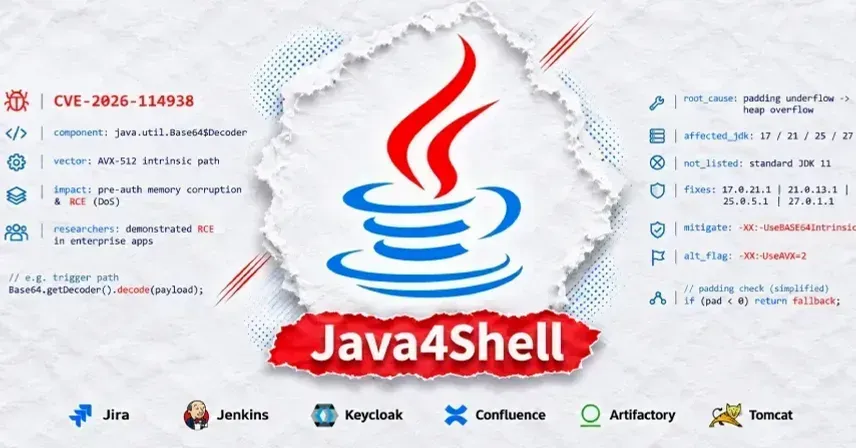
A critical security vulnerability dubbed Java4Shell has sent ripples through the tech community after researchers at the firm Calif revealed that attackers could seize control of high profile servers without needing a password. The flaw, tracked as CVE-2026-114938, allows for pre authentication remote code execution across several industry staples including Jira, Jenkins, and Keycloak. By sending specially crafted strings to services that decode Base64 data, such as login headers or security tokens, hackers can bypass traditional security checks and potentially execute their own commands on a target system.
Interestingly, this vulnerability is not universal but depends heavily on specific hardware configurations. It exclusively affects systems running Java 17.0.6 and later on x86 64 Intel and AMD chips that support a particular performance feature known as AVX 512 VBMI. Because the bug resides in a high speed version of Java’s decoder designed for these specific processors, a single software image might be vulnerable on one server while remaining perfectly safe on another using different architecture, such as ARM64 chips.
To achieve full system compromise, the researchers utilized a sophisticated technique they called JavaBleed. This process involves manipulating the server’s memory to expand neighboring arrays via an overflow, allowing them to read and write sensitive data until they reached the part of Java capable of executing code. While other security labs have successfully triggered system crashes and memory leaks using this method, reproducing full remote code execution has proven more difficult due to dependencies on precise memory layouts and network timing.
In response to the discovery, Oracle and the OpenJDK project have rushed out patches to close the hole. Amazon has already updated its Corretto builds, though Red Hat is still finalizing its fixes. Despite the severity of the flaw, which carries a high CVSS risk score of 9.2 from Calif researchers, Canada’s Cyber Centre reports that there are currently no known instances of this being exploited in active wild attacks. Administrators are urged to check their CPU flags and update their Java installations immediately to mitigate the risk of unauthorized takeovers.